

There’s a name for that sinking feeling that hits on Sunday night — the quiet dread, the tightening chest, the sudden awareness that tomorrow is Monday.
We call it the Sunday Scaries, but for many, it’s more than a fleeting mood. It’s a nervous system signal that your week is misaligned — and that your system doesn’t feel safe heading back into it.
For years, I tried to “fix” my Sunday nights with productivity: finish the laundry, meal prep, check the calendar, clean the inbox. And while it gave the illusion of control, I still felt the same pit in my stomach.
It wasn’t until I started treating Sunday as a nervous-system anchor — not a prep session — that the spiral stopped.
Here’s how my Sunday Reset looks now. And why it works — not just for my to-do list, but for my body, clarity and sense of self.

Why Sunday anxiety is often a regulation issue — not a planning one
Many people assume their Sunday dread is about tasks left undone. But the real issue often runs deeper: your nervous system is anticipating overstimulation, overexertion or emotional disconnection.
In 5 Minute Nervous System Reset You Can Do Anywhere, I explain how unprocessed stress carries into the next week if it isn’t discharged. Your Sunday evening isn’t just about Monday — it’s about everything unintegrated from the week before.
This is especially true for high-functioning, burnout-prone people. In The Unspoken Burnout of High-Functioning Women, we see how women often carry invisible emotional labor across weeks — until Sunday night becomes a breaking point.
So we don’t just need productivity. We need nervous system closure.
The Sunday Reset Flow: What I do (and don’t do) to stay grounded
This reset isn’t about performance. It’s about protection — of your emotional clarity, mental space, and sense of personal rhythm.
1. I begin with slow subtraction, not quick planning
Instead of asking, “What do I need to do this week?” I ask,
“What can I release from last week?”
I take 10–15 minutes to:
- Write one sentence about what felt heavy
- One sentence about what felt good
- One sentence about what I’m ready to let go
This acts as a soft closure for the week that passed — and creates emotional space for the one ahead.
Relevant read: When Your To-Do List Reflects Your Fears, Not Your Values — this spiral often begins when we carry fear-based urgency forward without question.
2. I do a 3-layer body scan — and follow it with care
Sunday reset is physical first. If I feel tension in my chest, jaw, or gut, that’s my cue that planning will not help until I regulate.
I ask:
- What part of me feels tense? (body)
- What is that part protecting me from? (emotion)
- What does it want instead? (need)
Then I give myself one act of physical regulation:
- A warm bath
- 15 minutes of non-goal movement (stretching, walking, swaying)
- Eyes closed, hand on chest, deep breathing (4-6 pattern)
Why it works: Nervous system literacy precedes effective executive function. You can’t plan your week from survival mode.
Also explored in: Too Wired to Sleep? Try This Calming Fix – because Sunday sleep issues often stem from unresolved tension.
3. I create “one gentle container” for the week
Instead of filling a planner with 20 micro-goals, I ask:
What’s the one feeling I want to practice this week?
Maybe it’s spaciousness. Or curiosity. Or slowness. I write it down and make it my week’s anchor.
Then I let that word guide what stays and what goes.
For example:
- If my word is ease, I say no to a networking call
- If it’s focus, I remove passive distractions (background tabs, podcast overload)
This is value-aligned planning, not pressure-aligned reacting.
It builds on what I explored in Vision Without Rush: Why Slow Goal-Setting Works Better — because real clarity comes from fewer, truer intentions.
4. I clean my physical space as an act of nervous system dignity
This isn’t a Pinterest-worthy deep clean. It’s a tactile ritual of order and breathability.
I reset:
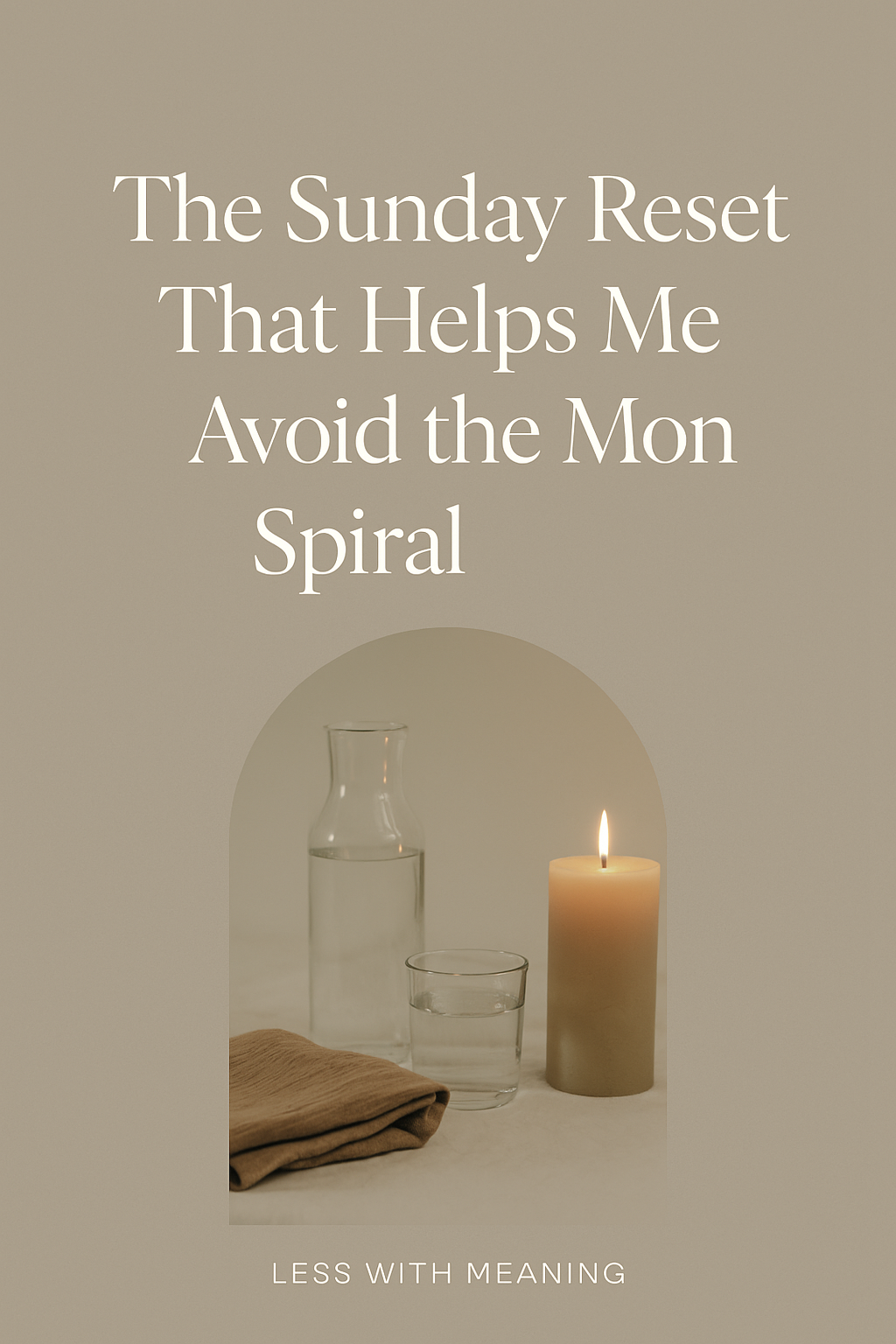
- My nightstand: candle, water, one book
- My workspace: clear desk, notebook, sunlight
- My kitchen table: linen cloth, one bowl of fruit, a clean surface
This isn’t about aesthetics. It’s about telling my body: “This space will support you, not overwhelm you.”
In The Linen Effect: How Wrinkled Texture Creates a Soothing Home, we look at how physical environments influence regulation — and how linen, natural light, and lived-in imperfection calm the nervous system far more than sterile “neatness.”
5. I end with a pleasure ritual, not performance
Sunday is not a rehearsal for productivity. It’s a re-rooting.
So I end with something that brings no “value” other than joy:
- A bath with music I love
- Reading fiction in bed
- Wrapping up in linen sheets and watching the sky dim
The point is not the activity — it’s the message to your system:
You are not a tool.
You are not preparing to perform.
You are living, and you deserve soft rituals.
Why this reset works (even when I’m low-energy)
This works because it’s not a demand. It’s an offering.
Unlike past Sunday rituals that were filled with bullet journaling and over-planning, this approach:
- Begins with emotional closure, not task buildup
- Honors the body first, not the calendar
- Anchors in values, not vague ambitions
- Leaves room for rest, not more “prepping”
Even on my worst weeks — especially on my worst weeks — this gentle container keeps me from slipping into fragmentation.
You don’t need to fix your Sunday. You need to feel safe in it.
The Monday spiral begins when Sunday night becomes a signal of dread, not possibility.
But you don’t have to fight it with force.
You can greet it with rhythm.
A reset doesn’t have to be perfect to be powerful. It just has to be honest, nervous-system-safe, and made for you — not for productivity.
Sources
- Cozolino, Louis. The Neuroscience of Human Relationships, 2022
- Levine, Peter. Healing Trauma, 2020
- Psychology Today: “Sunday Night Anxiety and How to Respond,” 2022
- Tawwab, Nedra Glover. Drama Free, 2023
- Harvard Health: “Why Your Brain Needs Ritual,” 2021